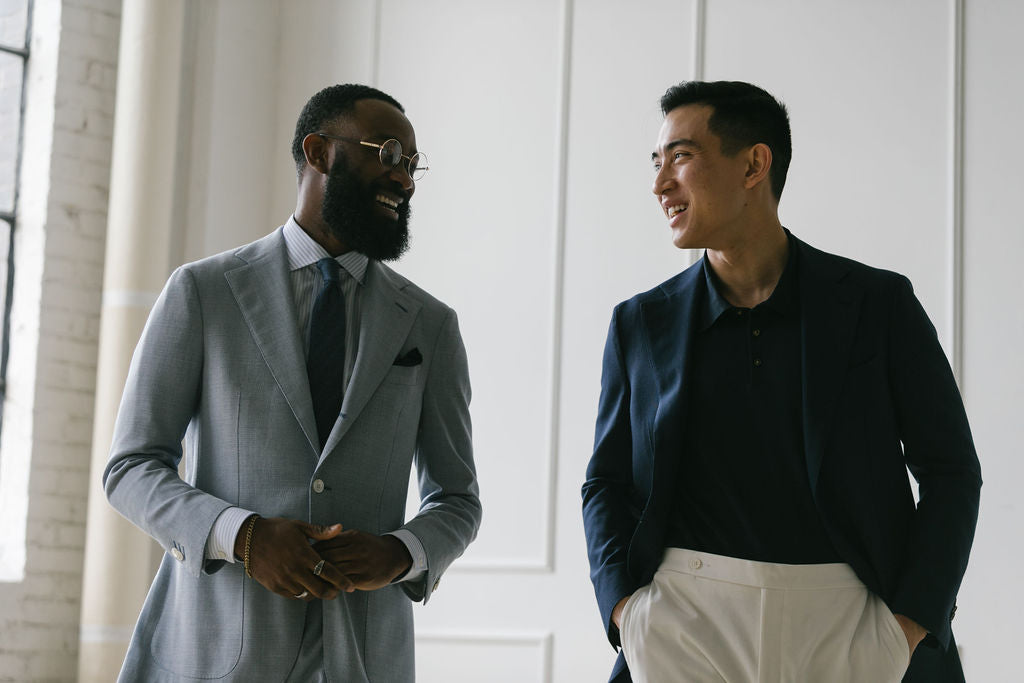

In today’s more casual fashion climate, many men are looking for suits that offer versatility—garments that can be broken down and worn as individual pieces. A well-designed suit that works as separates provides significantly more outfit options and better long-term value.
But not every suit jacket looks right with jeans, and not every trouser stands well on its own. Here’s what actually makes a suit work when worn as separates.
Fabric Matters
The foundation of a versatile suit begins with fabric selection. To ensure each piece can stand alone, avoid overly shiny, smooth, or silky cloths that immediately read as formal suit jacket when worn casually.
Fabrics that work especially well as separates:
-
Flannel
With its soft, slightly brushed texture, flannel feels relaxed and natural. A flannel jacket pairs easily with denim or chinos, while the trousers work well with knitwear or casual shirts. -
Seersucker
A summer favourite. Seersucker suits break apart effortlessly—the jacket works with jeans, while the trousers pair well with polos or lightweight shirts. -
Corduroy
Originally a workwear fabric, corduroy (especially fine pin-wale) integrates naturally with casual wardrobes and complements denim exceptionally well. -
Wool–Linen Blends
These fabrics strike an ideal balance between structure and ease. The open weave gives the jacket a blazer-like feel when worn separately.
Note: Open-weave fabrics may pill more quickly with frequent wear, so durability should be considered if the suit will see heavy rotation.
Design Details That Make a Difference
Shoulder Construction
One of the most important factors in whether a suit jacket works as a separate is the shoulder.
-
Soft shoulders
Minimal or no padding creates a relaxed silhouette that reads more like a blazer when worn casually. -
Structured shoulders
Heavy padding or roping at the sleeve head tends to feel overly formal and can look out of place with jeans.
Button Configuration
-
Three-roll-two
A subtle detail that introduces softness and casual character while maintaining clean lines. -
Two-button
Slightly more formal, but still workable depending on fabric and other design choices.
Pocket Styles
Pocket selection has a major impact on formality.
-
Chest pocket
A curved barchetta pocket works well dressed up or down. A patch chest pocket leans even more casual. -
Hip pockets
-
Flap pockets offer business versatility
-
Jetted pockets are clean but slightly more formal
-
Patch pockets immediately signal casual wear and pair best with denim
-
Sleeve Buttons
-
Formal: Four kissing buttons
-
Casual: Fewer buttons or wider spacing for a more relaxed, understated look
Lapel Style
-
Notch lapel
The most versatile option and ideal for suits intended to be worn as separates. -
Peak lapel
Typically too formal and best avoided if you plan to wear the jacket casually.
The Final Verdict
Designing a suit that works as separates is about restraint. The goal is to make the jacket feel more like a blazer when worn on its own—and the trousers strong enough to stand without their counterpart.
By choosing the right fabric, softening construction, and avoiding overly formal details, you create garments that adapt effortlessly between business and casual settings.
Whether commissioning a custom suit or selecting one off-the-rack, these principles will help you build a wardrobe that works harder—and wears better—over time.